
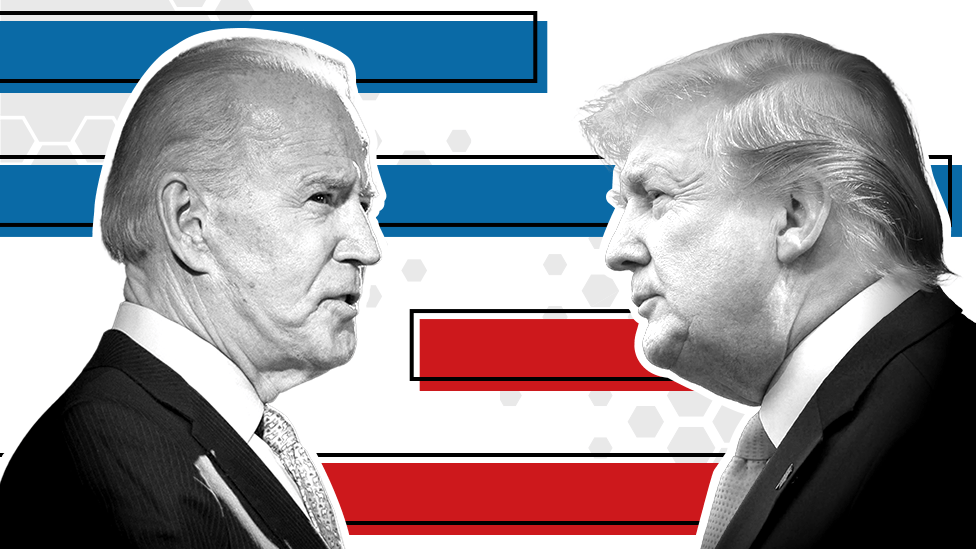
It’s the eve of the US election and it’s no exaggeration to say that the world is watching. By tomorrow, we will have a fairly good indication of whether the American people chose Trump or Biden. I really wish I wasn’t typing this, but no matter the outcome, I’m concerned.
The thing is that even if Biden wins, Trump isn’t going to go away. That fact has huge political implications.
The shape of this election has already been significantly altered by Covid-19; postal ballots and early voting being the principle examples. Yet even before any of us realised how much Covid would change the logistics of voting, Trump was on the attack.
Let’s rewind…
Trump’s win in 2016 was tainted by allegations of Russian meddling. It’s something he talks (and tweets) about quite a lot, 341 times to be precise.
In some ways, this fixation is quite understandable: the allegation alone undermined his legitimacy and authority, and for a someone like Trump that’s not easily forgotten. However, it’s also a big problem.
Disproving Russian collusion has become one of Trump’s biggest talking points. He’s called it a hoax, a plot, a conspiracy, and levelled criticism at the media, political establishment, and democratic process. More specifically, his version of damage control has been to direct attention toward other types of election fraud and the credibility of the electoral process as a whole.
What is concerning is that he was taking about this long before Covid ensured the huge numbers of US citizens voting by mail. In essence, Trump has engaged in a cynical, long term strategy to ensure that the outcome of the 2020 Presidential race will be contested no matter who wins.
This is actually something I’ve been documenting on Twitter for a while now (though truth be told in a distinctly less neutral tone). Highlights include an ad for Trump 2024, 2028, 2032, 2036 etc, and a charge that 51 million ballots have been sent out to non-existent people in an attempt to “steal” the election. It’s not exactly cheerful reading.
Am I being paranoid?
Probably. It comes with the territory.
This isn’t just rhetoric though. This issue has already had very real ramifications for deciding who can and cannot vote in this election, and that debate will continue long after the results are announced.
In North Carolina, early statistics showed that ballots from Black, Hispanic, and Native American demographics were between 3 and 5.5 times more likely to be rejected than ballots from white voters.
In Texas, 127 thousand votes came into question when Republicans challenged the validity of drive-thru votes in Harris County. For now they remain valid, but the issue is still very much in contention.
What is significant is that Guilford County, NC and Harris County, TX both lean toward the Democrats.
What is going on?
Trump’s focus on fraudulent ballots has ensured that everyone, at all levels of politics, is questioning the validity of votes. As it stands this is primarily impacting the most vulnerable demographics, in contested regions.
It is not such a jump to suggest that if the vote is close in a number of key battleground states, the losing party will look to exclude certain ballots on a technicality, and thus overturn the vote.
One need only look to the Florida election in 2000 where the outcome was decided by a mere 537 votes to know that uncertainty and contestation remain a very real possibility, with significant implications for the balance of the electoral college.
What does it mean?
At the very least, this uncertainty means that the winner of the presidential race will be subject to an unprecedented level of scrutiny. His right to govern will be questioned at every turn.
At worst, cries of voter fraud could launch a national enquiry, nullifying the efficacy of a Biden administration and potentially overthrowing the result entirely. I suspect that if this is this case we could see the biggest demonstrations on US soil in a generation.
Don’t get me wrong. I want Biden to win, I really do, but even if he does, Trump is not going to accept the validity of the result.
Tradition dictates that presidents stay largely out of politics after their tenure comes to a close. Trump, with his 87 million Twitter followers, magnetism for media attention, and refusal to conform to the traditions of the political establishment mean that he is ideally placed to play havoc with the outcome of a close election.
Win or lose, Trump has positioned himself perfectly to delegitimise the way that votes are counted and cast in the United States. As President, he could use tomorrow’s results as an excuse to overhaul the democratic process en masse, disproportionately benefitting the Republican party for decades to come. As ex-president, Trump will use his considerable platform to paint himself as the victim of electoral injustice, the president robbed of his power. Either way there isn’t a single thing Biden can do to stop Trump telling this story however he chooses, which means Biden has already lost.
 Steph Clarke